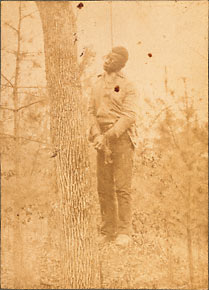
On January 14, 1889, a white woman reported that she had been raped and her son killed by an African American man. Over 400 white coal miners formed themselves into groups and brought several black men to the woman, who was unable to identify any of them as the alleged criminal. The next day, the miners brought Meadows, a new arrival to the area, and after a brief investigation, determined him to be guilty. The woman begged the mob not to lynch Meadows, as she was unsure if he was the criminal, but the mob went forward with the lynching and killed him near the Pratt Mines. Following his death, his body was shot multiple times and left in public view by an undertaker. Meadows was later buried in a paupers’ grave in what is now Lane Park in Birmingham, Alabama.
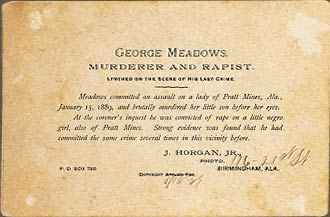
Cardmounted gelatin printingout paper. 4 1/4 x 6 1/2″
On January 16, the sheriff decided that Meadows was not the actual perpetrator of the crime, and arrested another African American man, Lewis Jackson.
Text on the back of the photo: George Meadows, Murder and Rapist. Lynched on the scene of his last crime. Meadows committed an assault on a lady of Pratt Mines, Ala. January 15, 1889, and brutally murdered her little son before her eyes. At the cornorer’s inquest he was convicted of rape ona little negro girl, also of Pratt Mines. Strong evidence was found that he had commited the same crime several times in the vicinity before. J. Horgan, Jr. Photo, Birmingham, Ala.
In 2019, Tony Bingham, a professor at Miles College and an advisor for the Jefferson County Memorial Project, announced his intent to either locate the site of Meadows’s grave or have the Birmingham Zoo or Birmingham Botanical Gardens (both of which are located in Lane Park) erect a memorial at their facilities. — Wikipedia